
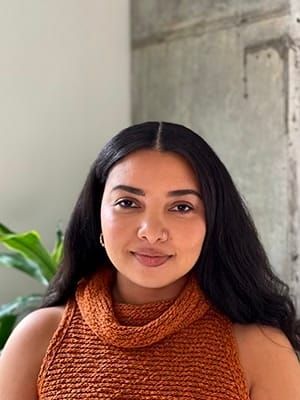
Interview with Elleza Kelley
Interviewed by Grace Ort
Edited by Zadie Winthrop
Elleza Kelley, an Assistant Professor of English and Black Studies at Yale, researches black literature in the United States. Her work focuses on black geographies and spatial practice, emphasizing the interplay between “space and place” as it pertains to American spatial thought. Professor Kelley graciously agreed to answer several questions about her work, including her articles “Follow the Tree Flowers: Fugitive Mapping in Beloved” and “Roofscapes: Narrative Geographies of Fugitive Praxis.” She discusses how studies of spatiality add to our understanding of literature. She also explains how fugitivity and racial enclosure play out in famous works like Toni Morrison’s Beloved. Finally, she elaborates on the research process and inspiration for her current book project: Flight Lines: A Poetics of Black Space.
A lot of your work involves ideas of form, space, and enclosure, particularly as these ideas appear in African American literary production. Can you elaborate on what each of these terms mean in your work? What does a study of spatiality add to the “typical” ways in which we understand literature?
Rather than focus on specific geographic locations, my work is primarily interested in how cultural production might help us trace the spatial thought and theory of African Americans, historically associated with dispossession and forced migration. Because of the history of slavery and its legacy in this country, African Americans have been more often considered workers of land than owners or shapers of it. In my work I try to expand our understanding of spatial production and spatial practice to include engagements with natural landscapes, architectural technologies, and the built environment that are not about domination, colonization, ownership, or development but that are nonetheless critical and transformative. The distinction between space and place is unstable, subjective, and varies greatly depending on the context. The overarching tendency is to define the terms based on a distinction between abstract and concrete. Place is frequently used to signal location and the local, a place you can point to on a map, a place you’ve been, a place you remember, space transformed by human presence and given a name. Whereas space (as I just used it in the previous sentence) is often used to evoke abstract space, the idea of space rather than a specific location. I use “space” more often because I do want to gesture to the theoretical and abstract, however, in general, the distinction is not particularly important to me because it sets apart the “global” and the “local,” the named and socially constructed, from the conceptual and abstract. On the contrary, I believe those levels are deeply entangled, especially for black people inhabiting, occupying, and co-producing Western space. A good example are the terms “taking up space,” “out of place” and “put in place.” We see these happen at abstract and material levels when it comes to how space is racialized, policed, and continually produced through exclusion, dispossession, abandonment, and violence. Part of my aim in Flight Lines is to emphasize that black contributions to geography are not only historical and ethnographic but epistemic and theoretical.
In my study of African American literature from the late 19th century to the present, I find that one of the most enduring and significant spatial forms that black characters and black authors are engaging with is “racial enclosure,” a term I define really specifically. In short, enclosure’s definitions and applications proliferate—it is at once a historical and legal process, a spatial and geographic form, and a system of knowledge that structures how we perceive the world around us. Of course, an enclosure is a pen or a space enclosed by fences or walls. But it also has a historically specific meaning: enclosure refers to the legal process that facilitated the transformation of the English countryside from commonly held land (or “the commons”) to privately held land, which occurred between the 15th and 19th centuries. Through a series of parliamentary acts, land that had been previously shared by people—so anyone could forage, hunt, grow crops and graze livestock on this land—was seized by wealthy landowners, fenced in, and declared to be private property. So, enclosure describes this specific historical process of England’s capitalist transformation and it also describes the more general act of making something into property, or privatization. Thus, enclosure has these material, abstract, and legal/historical valences that, I argue, come together in the context of the New World to which enclosure was imported and used as a tool for colonization, enslavement, American imperialism, Indigenous dispossession, and later, displacement, labor exploitation, mass incarceration, urban renewal, gentrification, and so on and so forth. This particular deployment of enclosure, I suggest, is highly racialized and multiscalar. Artistic production helps us see its multi-scalar nature and also see how enclosure emerges as aesthetic form. While black subjects engage enclosure’s forms in the world, black writers and artists engage its forms on the page.
While the content of the literature and art I examine in my book is important in an ethnographic way—that is, in its portrayal of black characters engaging with the architectures and geographies of racial enclosure—aesthetic form, I argue, is where spatial thought and theory become encoded. It’s where we see black writers and artists articulate and sort of “transcribe” their own “senses of space,” to riff on the great scholar of black geographies, Katherine McKittrick. Form also matters to me because it is one way that space and literature are connected: what does the form of the fence or gate have to do with the literary forms black writers were taking up in the mid-19th century? Ultimately, my book argues that to “see” black spatial thought and practice in literature requires that we look beyond literature at broader black aesthetic practices—or black aesthetic forms—and that where black visual art meets literature actually reveals spatial sensibilities and theories that are unique to black culture and to black philosophical, spiritual, and political traditions. This is why each chapter of my book explores art alongside literature. So that’s a major way in which spatiality disrupts and reconfigures our reading practices.
What has drawn you to studying these topics?
There are so many origin stories that might account for what draws me to these topics. One is simply that I’m a proud third generation New Yorker and when you grow up in New York City, you have a very unique sense of space. I didn’t realize that until I moved away for college. And, of course, it was then I learned that everyone has a unique sense of space: practices of navigation, the ways they remember itineraries or think about street names, how you tell when someone is “of” a place versus “in” it. So, there are also all these sociocultural elements that go into something which can seem purely empirical and objective, like navigation, location, mapping. I grew up with a whole map in my head that looked nothing like the map you get in the tourist shop when you come to visit NYC. We had our own ideas about where the borders of neighborhoods started or ended and what they were called and the kind of etiquette and ritual around that. How to walk down certain streets, which stores had what, or what trains would get you where fastest. So when I got to college, my own hometown became defamiliarized to me and I was taking all these anthropology classes, and so I became fascinated by all these infinitesimal codes and maps and practices through which people know, navigate and theorize the places where they live, that haven’t and couldn’t and shouldn’t be geographically formalized. And I got really into the ways that cultural production—books, music, art, films, drama, etc.—becomes one of the only repositories for that knowledge. So now, especially, I love learning about how other people know their own home places outside and against these more official, authorized representations.
Your article, “Follow the Tree Flowers: Fugitive Mapping in Beloved” discusses the hidden archive of geographic practices that make fugitivity possible. Can you talk about the research that went into this article? In “Follow the Tree Flowers,” you suggest that Morrison’s Beloved can be thought of as a map in itself. Can you say more about this idea? How does reading Beloved in this way add to our understanding of black resistance throughout American history?
This article was a chance for me to survey the field of critical cartography and try to understand what the insights of black studies and literary studies might bring to it, and vice versa. So, the research involved exploring this scholarship and trying to find points of connection and resonance. One of my primary methods is close reading, which I use to uncover insights about spatial thought and practice through aesthetic form. The idea of reading works like Beloved as a map is to use the revelations of critical cartography to suggest that literature also offers us ways of knowing spaces—for my purposes, distinctly black ways of knowing space. So, as Morrison describes the escape of the chain gang, or maps out the interior of 124 Bluestone Road, she teaches us about position, location, and navigation. But I also mean map as in guide, a repository of knowledge about traditions of fugitive praxis that might inform black resistance today. In her excellent book How to Lose the Hounds: Maroon Geographies and a World Beyond Policing, Celeste Winston writes about how storytelling can serve as a technology, sustaining the memory of marronage for its inheritors. I think “Follow the Tree Flowers” suggests something similar about the capacity of narrative to remember, store, transmit, and sometimes protect (through obscuring) valuable insights about insurgency, fugitivity, resistance, and beyond. If Paul D and the rest of the chain gang discover that being tethered together—as black people are—is not only a burden but a strength, how does that help us reimagine ourselves a diverse community with the potential force of collective action? We also see the fugitives rely upon others, especially a community of marooned Cherokee who render them life-saving aid and new forms of navigation. So, the book, while fictional, teaches us something about how people have survived the violence and enclosure of racial capitalism across space and time. Of course, Morrison is not only thinking of the 1870s—she’s writing in 1987, so her representation of this scene of fugitive navigation is already informed and shaped by centuries of black resistance and, in particular, by more recent movements and revolutionary figures like Assata Shakur.
Through the urban roofscape, your article “Roofscapes: Narrative Geographies of Fugitive Praxis” explores the forms that geographies of fugitivity take. Can you discuss how these ideas inform our modern conceptions of race and property?
Race and space, especially urban space, are fundamentally entangled and give one another mutual coherence. One of the things I look at with the roofscape is how the so-called “deadzones” or “negative spaces” of the city become laden and attached to notions of race and racist fears and assumptions about blackness. And on the other hand, ideas about property and propriety get collapsed with one another and with whiteness. If we look at the history and discourse of urban renewal in the United States, for example, we see the promise of new development and wealth accumulation placed in contrast to “urban blight” and “slum clearance.” James Baldwin famously called urban renewal “negro removal.” So, you can see there how race and space get collapsed. But what is also being made in that collapse that is not visible to the naked eye? Here, I’m interested in exploring how fugitive relationships to urban space, like what we see (or don’t see) on the rooftop can complicate our perception of how space is racialized and how race is spatialized; reimagine the possibilities of seeming “dead zones” as places where life can happen beyond the purview of capital and the surveillance state that subtends it; open up how space is used beyond for the purposes of privatization or capital accumulation, and even let us reconsider the imperative to “use” space in particular, prescribed ways. In that article, however, I also suggest that the roofscape helps us more rigorously address not only the possibilities of fugitive frameworks but the limits, too.
What sparked the idea for your current book project, Flight Lines: A Poetics of Black Space? What has been your biggest challenge thus far in this project, and what are you most excited about?
My book is an elaboration of my dissertation project, which began even before graduate school in an amazing undergraduate course called “Anthropology of Cities,” taught by Daniella Gandolfo at Wesleyan. I used to be an anthropology major! I think that might reveal a lot about my approach to literature and my thinking about space. Anyway, I was doing this auto-ethnographic about growing up on New York City rooftops and I hit a wall trying to do research on this phenomenon. It just didn’t really have an archival life beyond police records, deaths, and accidents. And that wasn’t the story I was trying to tell. But I remembered this favorite childhood book of mine, Tar Beach by Faith Ringgold, and that’s when I realized all this stuff was recorded somewhere, just not where I expected it. So literature became my archive, in a way. And I began to wonder what other unaccounted-for spatial practice and knowledge could be found in African American literature.
The biggest challenge of the book has been setting parameters for myself. There are so many rich black geographies and black spatial practices in the United States alone—not to mention throughout the world—that it can feel limiting to write a book about such a small, narrow sliver of what I’ve called “a poetics of black space.” But at the same time, that limit has helped me let go and understand more fully the book’s contribution, which is a modest theory and proposition about method, which I hope will be taken up and used to explore all these other spaces and all these other questions and problems that form in the nexus of thinking black aesthetics and black geographies together. So that might also be what I’m most excited about—seeing how people use the book.
A lot of your work involves ideas of form, space, and enclosure, particularly as these ideas appear in African American literary production. Can you elaborate on what each of these terms mean in your work? What does a study of spatiality add to the “typical” ways in which we understand literature? What has drawn you to studying these topics?
These are great questions! I tend to notice anything that slips away from what we normally consider “objective” descriptions of space—dimensions, coordinates, location, climate, use or function. So, I really pay attention to emotion, sensory experiences, memories, as ways of describing space. I’m really drawn to strange descriptions that feel incomplete, incommensurate, or out of time. One of the lines I write about a lot comes from Beloved, where the protagonist explains to her daughter that “if you go there—you who never was there—if you go there and stand in the place where it was, it will happen again” (44). For Sethe (and Morrison, too) place is palimpsestic and almost archival. It remembers and preserves what was there before. Equally fascinating to me is the possibility that even if Denver, Sethe’s daughter, “never was there,” she could still experience a past she had never experienced, merely through physically being in a space. Another of my favorite descriptions of a space is also Morrison’s, from Sula, where she describes a fictionalized black neighborhood in Ohio called The Bottom as “the part of the world that mattered.” I’m so struck by that description. What does it mean to call geographies that have been historically neglected, degraded, poisoned, bulldozed, to say this is the part of the world that matters? Why does it matter? To whom? I think these questions help us understand the way Morrison crafted these stories set in all black worlds. And they weren’t just “neutral” or universal stories that happened to be black, they were stories told from the perspective of people immersed in and emerging from those worlds. For them, The Bottom is the center of the universe. So, she shifts the whole center of literature—of who is a proper literary subject and what kinds of spaces are proper literary settings. And in so doing, she documents another way of perceiving, experiencing, and engaging with the world; another sense of space. That’s what I’m continually interested in studying and taking seriously. That’s my guide.